
Helpful Articles
Cloud TMS Questions Enterprise Logistics Leaders Should Ask
Enterprise logistics operations are becoming increasingly complex. Multiple depots, fragmented systems, disconnected data sources, rising customer expectations, and pressure to improve efficiency all create significant operational challenges. Choosing the right enterprise transport management software is no longer simply an IT decision. It is a strategic investment that can directly influence profitability, scalability, customer service, and long-term competitiveness.
Yet many logistics directors focus on software features alone rather than asking the deeper questions that reveal whether a Transport Management System (TMS) can genuinely support growth across a complex transport operation. In this guide, we’ll explore the key questions enterprise logistics leaders should ask when evaluating a cloud TMS, covering logistics analytics, transport software integrations, multi-depot operations, automation, visibility, and future scalability.
Throughout the article, you’ll also discover how Mandata helps transport and logistics businesses overcome operational challenges through a connected, cloud-based transport management platform built specifically for logistics operators.
1. Can the TMS Provide a Single View Across All Depots?
One of the biggest challenges facing multi-depot operations is fragmented visibility. Different depots often operate with varied processes, systems, spreadsheets, and reporting methods. This creates operational silos that limit decision-making and make it difficult to understand overall business performance.
When evaluating enterprise transport management software, logistics leaders should ask whether the platform provides a true single source of operational truth.
Key considerations include:
- Centralised job management
- Shared customer information
- Cross-depot fleet visibility
- Unified driver management
- Consistent reporting across locations
- Real-time operational oversight
Mandata Transport Management Software (TMS) enables logistics businesses to manage multiple depots through one integrated platform. Transport managers can view jobs, vehicles, drivers, and performance metrics across the entire operation, helping improve collaboration and operational control.
Bring Every Depot Together
Discover how a connected transport management platform can improve visibility and control across your entire logistics operation.
2. How Advanced Are the Analytics and Reporting Capabilities?
Modern logistics businesses generate enormous volumes of operational data. However, without meaningful analytics, that data delivers little value.
Enterprise logistics leaders should ask:
- What KPIs can be monitored?
- Can profitability be analysed by customer, route, depot, or vehicle?
- Are dashboards available in real time?
- How easy is it to create custom reports?
- Can trends be identified before they become problems?
Effective logistics analytics allow organisations to move from reactive management to proactive optimisation. Leaders gain the insights needed to reduce costs, improve asset utilisation, and identify growth opportunities.
Mandata provides operational and financial reporting capabilities that help businesses analyse performance across multiple areas, enabling more informed decision-making and continuous improvement.
Benefits include:
- Profitability analysis
- Resource utilisation reporting
- Depot performance measurement
- Customer profitability reviews
- Exception management reporting
Turn Data Into Better Decisions
Understanding what modern transport management software can achieve is the first step towards operational improvement.
3. How Well Does the Platform Integrate With Existing Systems?
Many transport businesses already rely on a range of software solutions, including:
- ERP systems
- Warehouse Management Systems (WMS)
- Finance platforms
- Telematics solutions
- Customer portals
- Fleet management platforms
Without seamless integrations, teams often spend valuable time manually re-entering information across multiple systems.
A critical evaluation question is: “Can this cloud TMS integrate with our existing technology ecosystem?”
The best transport software integrations eliminate duplicate data entry and improve information accuracy throughout the organisation.
Mandata provides integration capabilities that support connected workflows between transport operations and wider business systems, creating smoother data flows and reducing administration burdens.
This delivers:
- Improved efficiency
- Fewer manual errors
- Faster information sharing
- Better customer communication
- Enhanced operational visibility
Connect Your Entire Logistics Technology Stack
Learn how integrated transport management software can streamline workflows throughout your organisation.
4. Will the TMS Improve Planning Efficiency?
Transport planning remains one of the most resource-intensive and complex functions within logistics operations.
Enterprise leaders should ask:
- How quickly can planners allocate work?
- Can routes be optimised automatically?
- Does the system reduce empty running?
- Can planners manage larger workloads efficiently?
- Does it support dynamic operational changes?
Planning inefficiencies can significantly impact costs and customer service performance.
Mandata helps logistics businesses streamline transport planning through intelligent workflows that support faster decision-making while improving vehicle utilisation and operational efficiency.
The result is:
- Reduced mileage
- Improved vehicle utilisation
- Better route management
- Faster planning decisions
- Increased operational productivity
See How Smarter Planning Improves Performance
Explore how modern transport planning tools can help reduce costs and improve efficiency.
5. Can the System Scale as the Business Grows?
Software that works for a small operation may struggle as a business expands.
A key question every enterprise logistics director should ask is: “Will this platform still support our organisation in five years?”
Scalability should include:
- Additional depots
- Fleet expansion
- Increased job volumes
- Additional users
- Wider customer bases
- New service offerings
A scalable cloud TMS enables organisations to grow without constantly replacing systems or redesigning processes.
Mandata is designed to support organisations ranging from growing transport operators to large, established logistics businesses, helping maintain operational consistency as complexity increases.
Build a Logistics Platform for Long-Term Growth
Discover how the right TMS supports both today’s operations and tomorrow’s expansion.
6. Does the TMS Improve Customer Service and Communication?
Customer expectations continue to rise.
Logistics businesses increasingly need to provide:
- Real-time updates
- Delivery visibility
- Electronic proof of delivery
- Accurate ETA information
- Faster response times
Enterprise transport management software should not only improve internal operations but also strengthen customer relationships.
Mandata helps streamline customer communication by bringing operational information into one central platform, helping personnel quickly access accurate information and reducing the time spent responding to customer enquiries.
Benefits include:
- Greater transparency
- Faster customer responses
- Improved service levels
- Enhanced customer satisfaction
- Reduced administrative workload
Deliver a Better Customer Experience
Learn how a connected TMS can strengthen customer relationships while reducing operational effort.
7. How Much Administration Can Be Eliminated?
Administrative inefficiency remains one of the biggest hidden costs in transport operations.
Enterprise leaders should evaluate:
- Manual data entry requirements
- Paper-based processes
- Invoice production times
- POD management
- Customer communication workflows
An effective cloud TMS should automate repetitive tasks and free operational teams to focus on high-value activities.
Mandata helps reduce administration through integrated workflows that connect transport planning, job management, proof of delivery, customer communication, and invoicing processes.
Potential benefits include:
- Reduced paperwork
- Faster invoicing
- Improved cash flow
- Fewer manual errors
- More productive teams
Reduce Transport Administration Across Your Business
See how automation can improve efficiency and free up valuable operational resources.
8. Does the Vendor Understand Logistics?
Technology alone is not enough.
Enterprise logistics leaders should assess:
- Industry expertise
- Product development focus
- Customer support quality
- Sector-specific functionality
- Long-term innovation roadmap
The best enterprise transport management software providers understand the unique challenges of transport and logistics operations.
Mandata has spent decades supporting transport operators and logistics businesses, developing solutions specifically designed to address the operational requirements of road transport, fleet management, planning, compliance, and customer service.
This sector-specific focus helps organisations implement technology that aligns closely with real-world logistics challenges.
Partner With Logistics Specialists
Discover why transport operators choose a platform built specifically for logistics businesses.
Why Many Logistics Businesses Choose Mandata
For enterprise logistics leaders evaluating cloud TMS solutions, the goal is not simply to digitise processes. It is to create a connected, scalable, data-driven logistics operation capable of supporting long-term growth.
Mandata helps organisations achieve this through:
- Enterprise transport management software
- Multi-depot operational visibility
- Advanced logistics analytics
- Integrated business workflows
- Transport software integrations
- Fleet and driver visibility
- Automation capabilities
- Scalable cloud-based architecture
By connecting planning, execution, tracking, reporting, customer service, and financial processes, Mandata enables logistics teams to operate more efficiently while gaining greater control over increasingly complex transport operations.
Cut Costs. Boost Efficiency. Stay Compliant.
See how Mandata TMS helps you reduce empty miles and maximise fleet performance across every job
Enterprise transport management software is a platform that helps logistics organisations manage planning, fleet operations, drivers, customer communications, tracking, reporting, and financial processes from a single system.
A cloud TMS provides centralised visibility across all depots, enabling businesses to manage jobs, vehicles, drivers, and performance data through one connected platform.
Logistics analytics help organisations identify inefficiencies, improve profitability, optimise resources, monitor KPIs, and make data-driven operational decisions.
A modern TMS should integrate with ERP systems, accounting software, warehouse management systems, telematics providers, customer portals, and other business applications.
A TMS can reduce costs by improving route planning, reducing manual administration, increasing vehicle utilisation, minimising errors, and automating workflows.
A TMS provides customers with delivery updates, ETA information, order tracking and electronic proof of delivery. This creates a better customer experience while reducing customer service enquiries.
Key considerations include scalability, analytics capabilities, integration options, multi-depot visibility, automation, operational control, customer service features, and logistics-specific functionality.
Mandata provides transport and logistics operators with a cloud-based platform that helps improve planning, visibility, analytics, integrations, customer service, and operational efficiency across complex logistics environments.
Download the Enterprise Logistics Leader’s Guide to Choosing a Cloud TMS
Whether you’re managing multiple depots, seeking deeper logistics analytics, improving transport software integrations, or planning for future growth, the right transport management system can transform your entire operation.
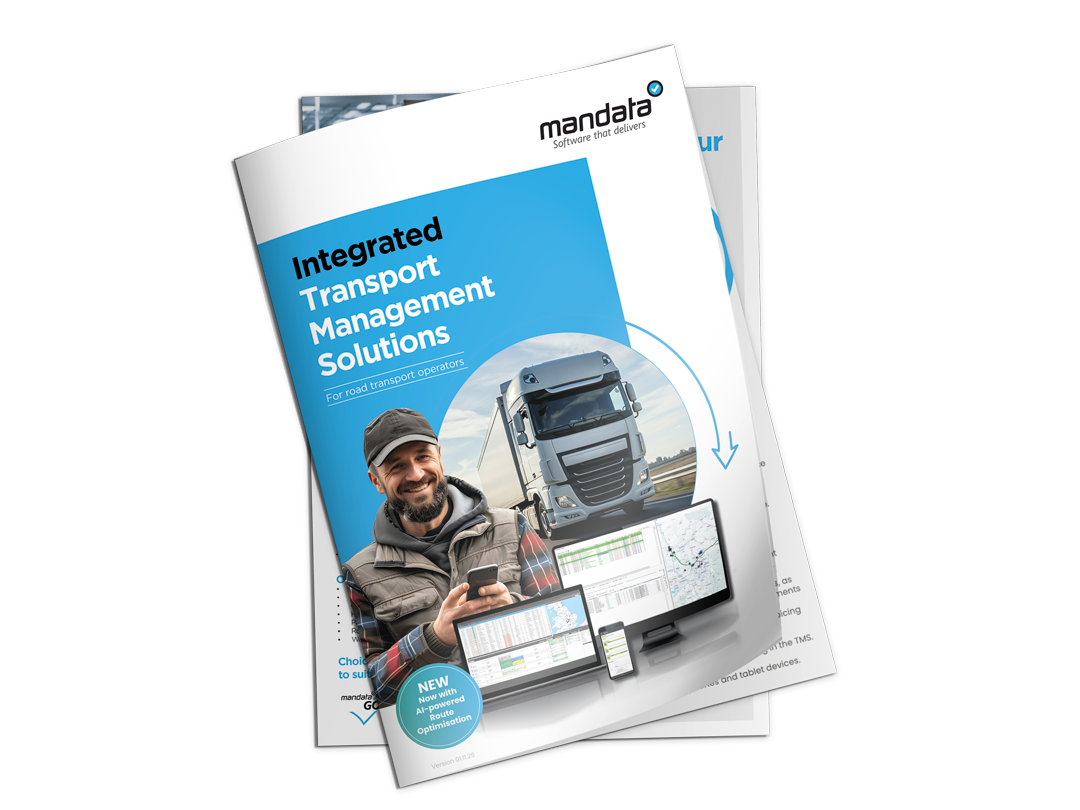
Complete the form below to download your Mandata TMS brochure and discover how enterprise transport management software can help improve visibility, efficiency, profitability, and operational control across your logistics business.